
How We Work: UX
A content-first approach to product clarity, usability, and delivery
UX work slows down when content shows up too late.
Design decisions are already locked. Flows are built on assumptions. Rework becomes inevitable.
Our work with UX and product teams follows Content-First Design, a practice that brings content and meaning into the process early so structure, flow, and interaction are grounded in real user needs.

How do UX engagements unfold?
UX work follows a clear progression rooted in the content-first double diamond.
Each stage exists for a reason. Skipping steps is how teams end up redesigning the same things twice.
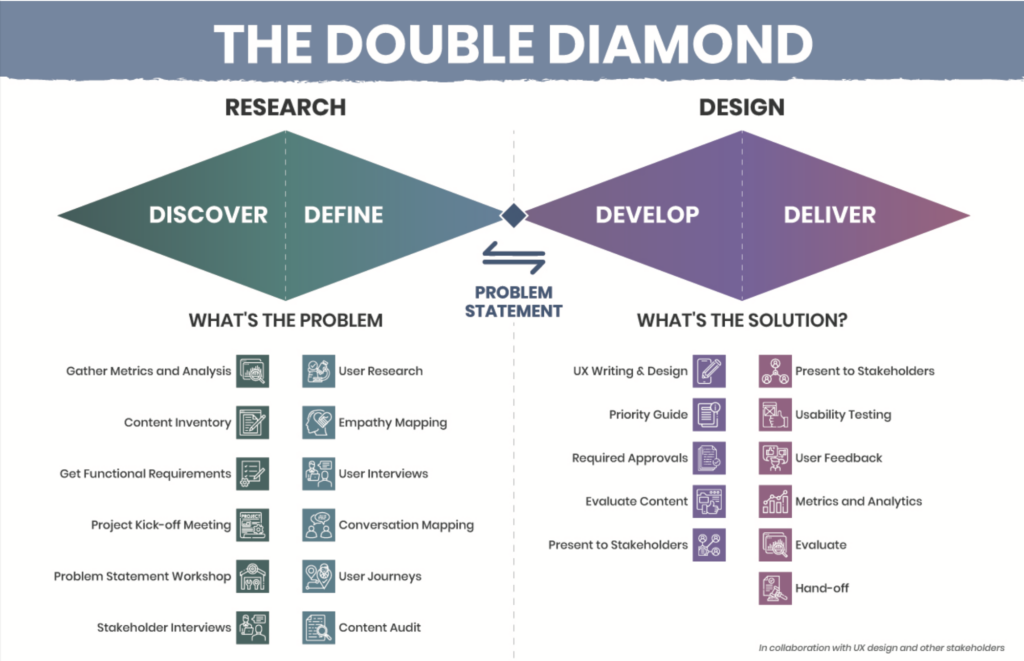
1. Discover
We understand the user conversation before design begins
We start by understanding what users need to know, decide, and do.
This includes examining existing content, user journeys, stakeholder inputs, and research to surface gaps, assumptions, and risks. Content is treated as a primary signal, not an afterthought.
What this produces
- Clear insight into user needs and context
- Visibility into content gaps and contradictions
- Shared understanding of what’s really being communicated
2. Define
We clarify the problem and the constraints
Discovery surfaces information. Definition turns it into direction.
In this stage, we align on problem statements, priorities, and design principles. Teams agree on what success looks like and what constraints must guide the work.
This is where ambiguity is reduced before design accelerates.
What this produces
- Clear problem statements
- Shared priorities and principles
- Alignment on what the experience must support
3. Develop
We design with content leading the way
Only after problems and constraints are clear do we move into development.
Content is used to inform structure, flow, and interaction. Prototypes are grounded in real language, not placeholders, so teams can evaluate meaning as well as usability.
This is where content-first design changes how decisions are made.
What this produces
- Content-first wireframes or prototypes
- Stronger collaboration across UX, product, and content
- Faster progress with fewer late-stage surprises
4. Deliver
We test, refine, and support real use
Delivery is where assumptions meet reality.
We support testing, iteration, and rollout to ensure the experience holds up under real conditions. Accessibility, clarity, and usability are evaluated to
The focus is on learning without reopening foundational decisions.
What this produces
- Usability and content testing insights
- Evidence-based refinements
- Experiences that scale without losing clarity
What can UX and product teams expect?
Artifacts are tailored to each engagement, but commonly include:
- Content discovery and inventory outputs
- Stakeholder and user research summaries
- Clear problem statements and design principles
- Content models or structural definitions
- Content-first wireframes or prototypes
- Priority guides and decision frameworks
- Usability and content testing findings
- Iteration recommendations tied to evidence
These artifacts are designed to:
- Bring content into the process earlier
- Reduce rework and late changes
- Improve usability and accessibility
- Support ongoing collaboration after delivery
We don’t optimize for artifacts.
We optimize for decisions teams can reuse.
What is it like to work together?
We work as partners inside the product team.
You can expect clear goals, direct feedback, and close collaboration with designers, product managers, and content practitioners. We don’t operate as a downstream service or a one-off reviewer.
The strongest signal of success is when teams start making content-led design decisions without needing to escalate them.
When is this approach the right fit?
Our UX work is best suited for teams who:
- Want content involved earlier in design
- Are tired of redesigning the same flows
- Care about usability, accessibility, and clarity
- Need a repeatable, defensible design practice
This approach is based on the process outlined in Content-First Design, published by XML Press, 2025, and adapted for real product teams working under real constraints.