Content-First Design: KPI-Mapped Case Studies
Where clarity shows up on the balance sheet
Stash Preferred Payment Method
Improve subscription collection by $3M/month
Overview
Today, the Stash Platform selects the best available payment method from which to collect a subscription fee on a per-collection basis, which means the user’s fee payment method may be different each billing cycle.
This creates a confusing and unpredictable experience for customers and makes it more challenging for Stash to provide fee collection transparency in the UX.
With this initiative, we’ll improve fee collection transparency and predictability by giving users the ability to select a “preferred payment method,”that we’ll always try to collect from first.
User problem
Who is impacted by this? All Subscribers
What are their pain points? Lack of transparency and predictability around subscription fee payment methods.
Opportunity & impact
What is the opportunity if we solve this problem?
Ease of use and greater transparency for customers
Decrease in support calls related to subscription fee collections
Increase in subscription fee collection success rate
Outcome
An uptick of up to 47.03% of PPM usage in the first month, increasing our subscription fee collection.
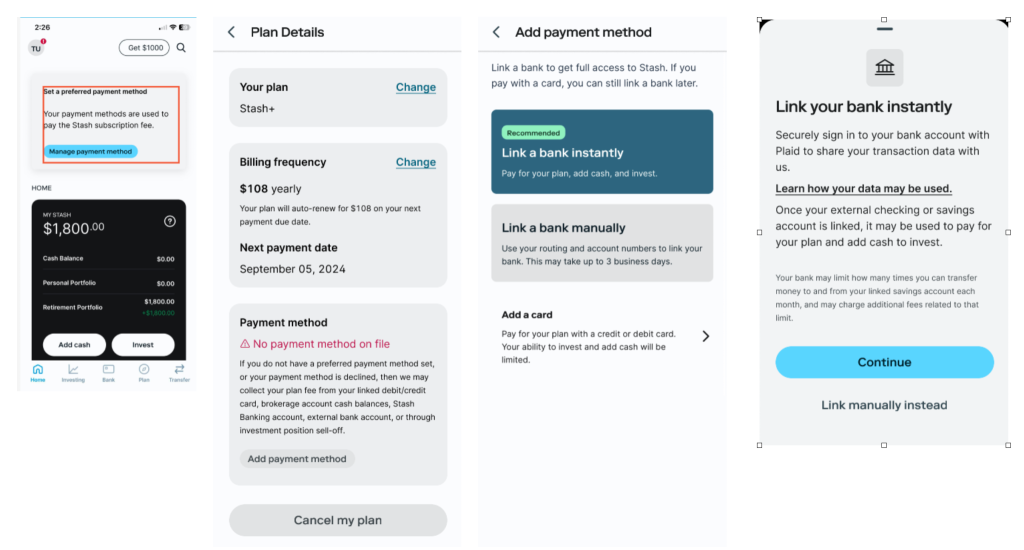
A selection of screens
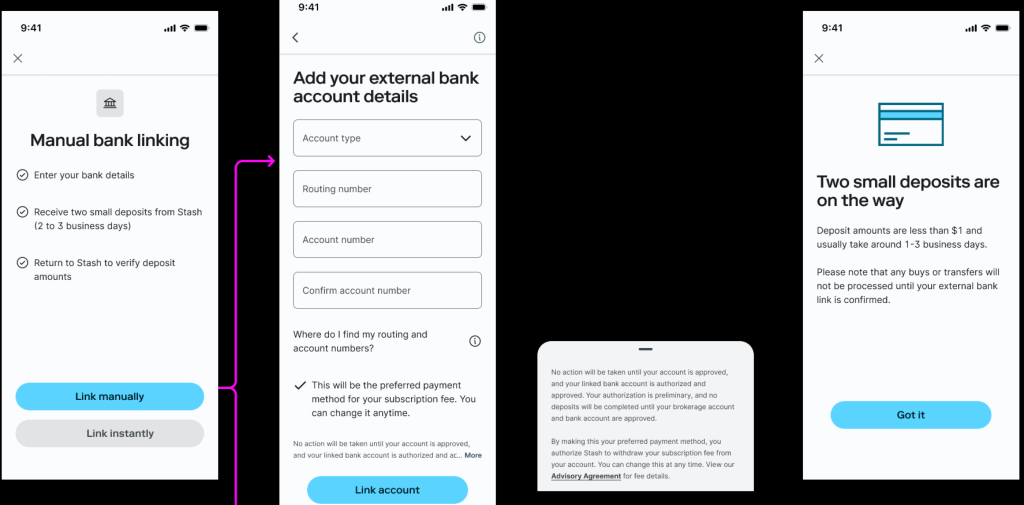
Entry points to preferred payment method
Manually set up your preferred payment method
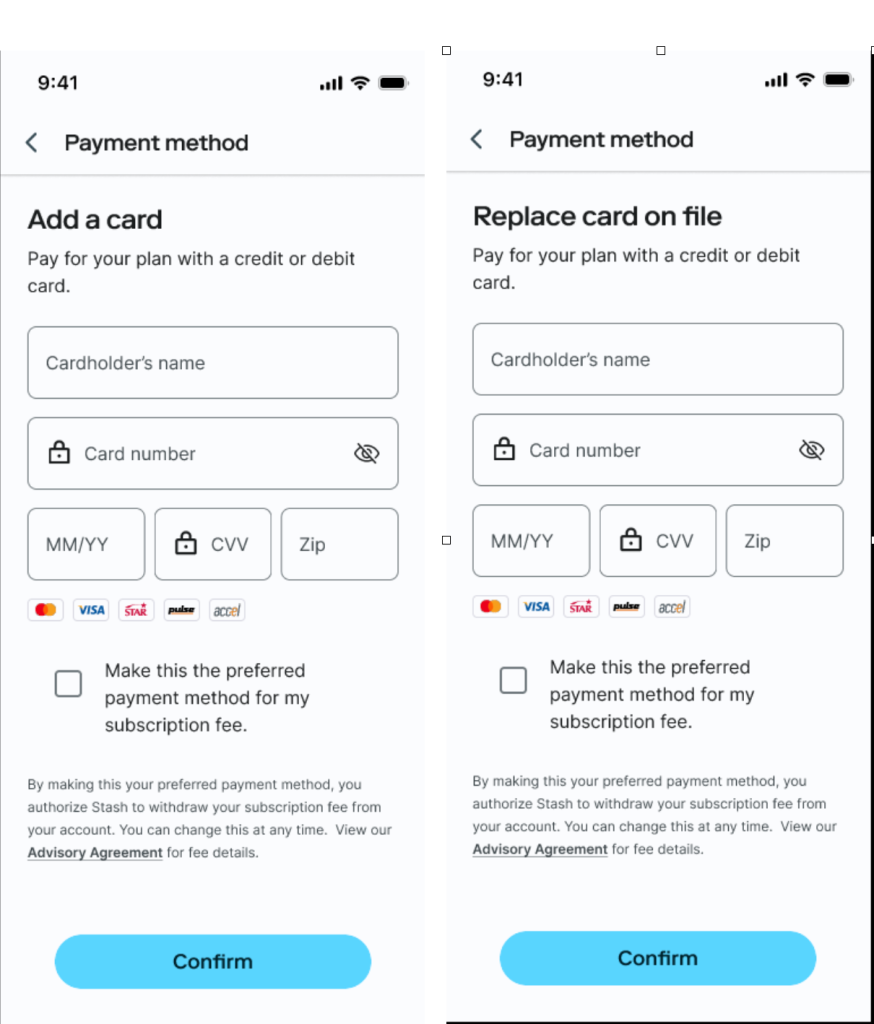
Enter or replace your credit or debit card preferred payment method
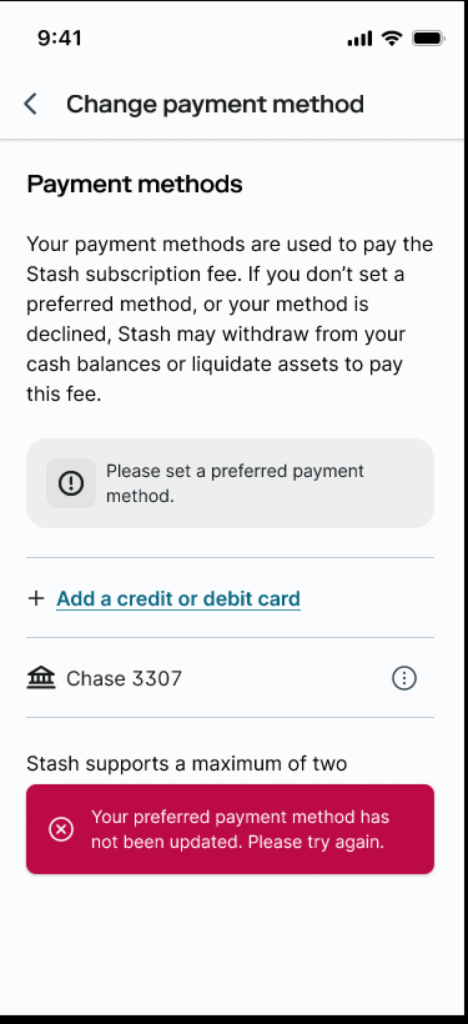
Change payment method
Next steps
- Usability exploration into the drop-offs
- User interviews
- Content and UX audits and reviews
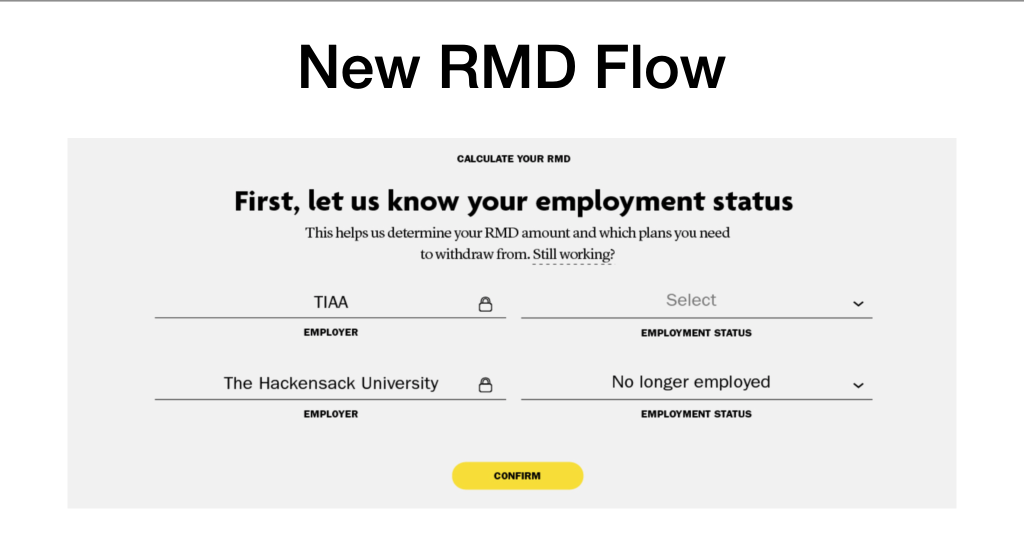
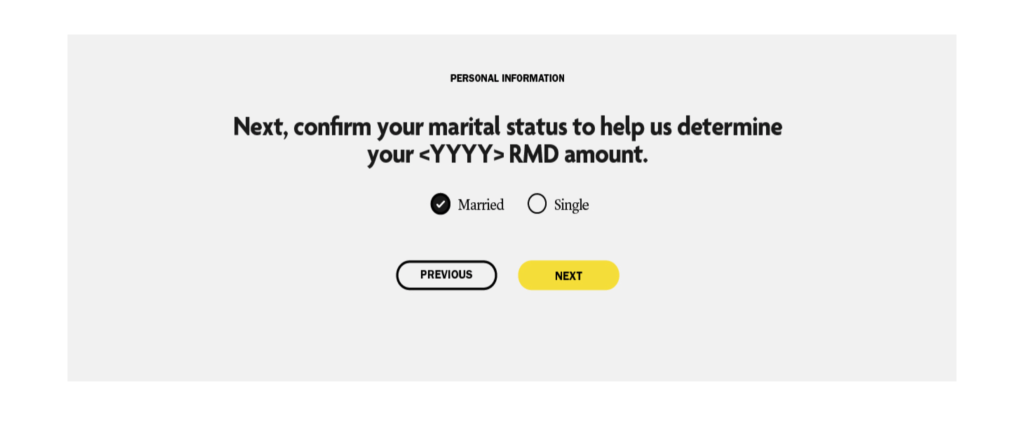
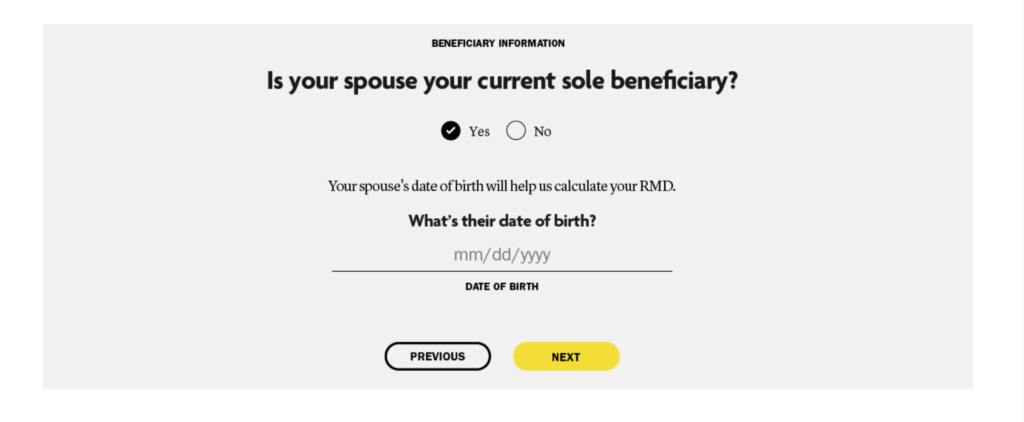
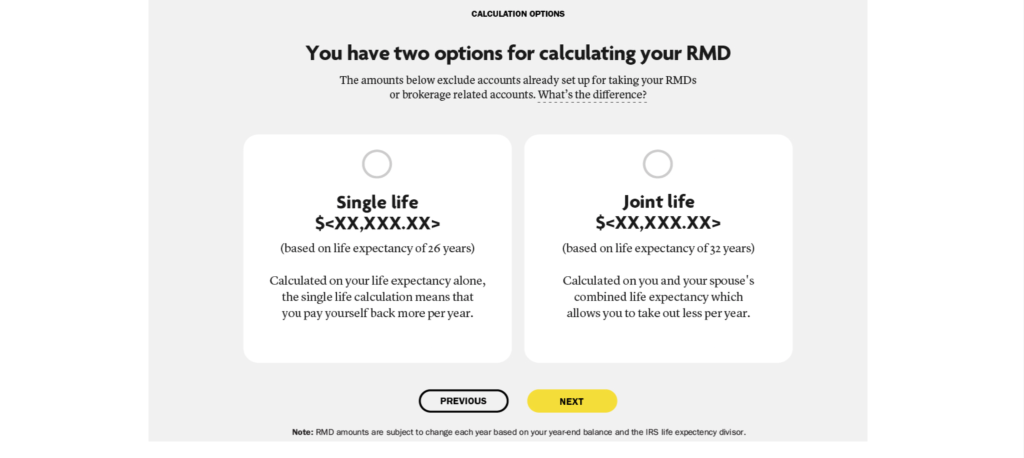
TIAA RMD
Improve completion rates by over 40% to reduce support calls, saving over $1M in the first six months
Research
Design thinking saved the day here, and revealed that these issues weren’t related to a single experience but to the site as a whole
Stakeholder interviews
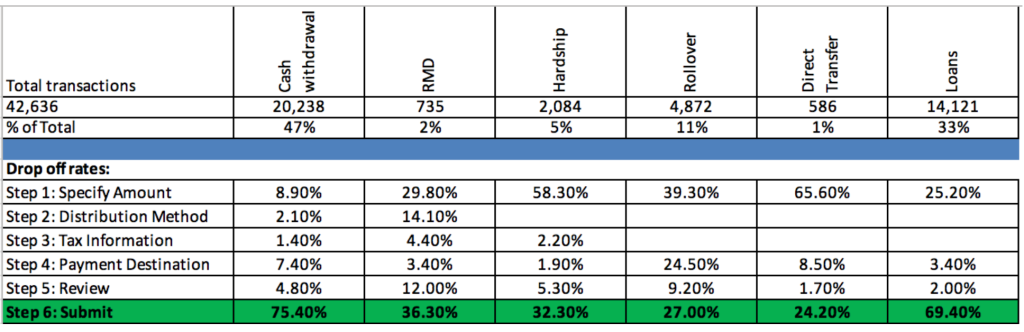
End-to-end systems analysis of all transactions with high drop-off rates and identifying the source of these pain points
Empathy mapping with customers
Conversation mapping between content/design and UX/customer.
User interviews
Listening in at the telephone support center
Usability studies with a focus on content
User problem
Not understanding what an required minimum distribution is or what the rules are
Frustrated with a complex process
Don’t understand why TIAA requires personal information online
Don’t want to spend the time to do the transaction online
Intimidated and distrustful dealing with money online
Stakeholder problem
Huge expense with calls to call center that took a lot of time per call
Need to increase revenue by saving on cost center and build customer trust and loyalty through seamless, easy user-experience
Project goals
Simplify a complex process
Set expectations for what customers will need, and how long the process will take
Tell them why we need personal information of any kind
Reassure them along the way that they are on track
Simplify, simplify, simplify
Create connection with complimentary features such as: decision support, virtual assistant, and SMS support
Reduce calls the call center
Initial metrics
Solution
Outcomes
Before revisions – Initial submission rate was 24.6%
After revisions – Final submission rate 71.1% for an increase of 46.5%
Saving over $1M over the first month for the call center
Next steps
- Continue to explore where drop-offs are happening with user interviews, usability studies, and further research with the goal of getting near a 100% completion rate.
- Apply learnings to other transactional experiences.
What changed
Content standards were defined before design or build:
- Plain-language rules
- Single source of truth per topic
- Content models that forced decisions before pages existed
Product KPIs
- Platform maintenance cost
- Time to publish updates
- System scalability without redesign
Marketing KPIs
- Message consistency across channels
- Conflicting or outdated information
- Trust and credibility signals
CX KPIs
- Call-center volume
- Failure demand (users needing help to complete tasks)
- Self-service task completion
ROI signal
- £50–60M annual savings from consolidation and reduced operational overhead
Leadership takeaway
- Content-first design functions as operational infrastructure, not a brand exercise.
What changed
Language and decision logic were clarified before UI refinement:
- User intent defined upstream
- Explanations rewritten as product logic
- Fewer “fix it in design” cycles
Product KPIs
- Task completion rates
- Rework during sprints
- Late-stage UX debt
Marketing KPIs
- Conversion through clearer value explanation
- Drop-off in critical flows
- Confidence in claims and positioning
CX KPIs
- Call-center volume
- Failure demand (users needing help to complete tasks)
- Self-service task completion
ROI signal
- Higher conversion in core flows + reduced support burden during tax season
Leadership takeaway
- Conversion problems are often meaning problems, not UI problems.
What changed
Policies and expectations were clarified before interface polish:
- Structured rules and fees
- Consistent language across product, email, and help
- Clear “what happens next” messaging
Product KPIs
- Edge-case failures
- Exception handling
- Reusable content patterns for scale
Marketing KPIs
- Trust signals at booking
- Booking confidence
- Trust and credibility signals
CX KPIs
- Disputes and refunds
- Support escalations
- CSAT tied to expectation-setting
ROI signal
- Lower support cost + improved booking conversion and retention
Leadership takeaway
- Trust does not scale visually. It scales linguistically.
What changed
Onboarding was re-sequenced around understanding:
- Concepts explained before tools
- Progressive disclosure driven by comprehension
- Content tested alongside usability
Product KPIs
- Activation rates
- Time-to-value
- Early churn
Marketing KPIs
- Trial-to-paid conversion
- Merchant confidence in product value
- Over-reliance on nurture and education campaigns
CX KPIs
- “ How do I start?” support requests
- Onboarding friction
- First-90-day satisfaction
ROI signal
- Faster growth with lower onboarding cost
Leadership takeaway
- If users do not understand the product, they cannot adopt it.