Many UX teams are feeling increasing pressure around discovery, even when there is broad agreement that understanding users and problems matters. Delivery timelines are tighter, confidence is higher, and organizational momentum tends to favour forward motion over reflection. In that environment, discovery is often compressed or quietly reshaped, not because teams have stopped caring, but because the cost of slowing down feels harder to justify.
What changes first is not usually the language of discovery, but its position. UX practitioners are brought in later. Problem framing arrives more fully formed. The work becomes less about shaping direction and more about refining execution. Over time, this can create a sense that discovery still exists in theory, but has lost some of its influence in practice.
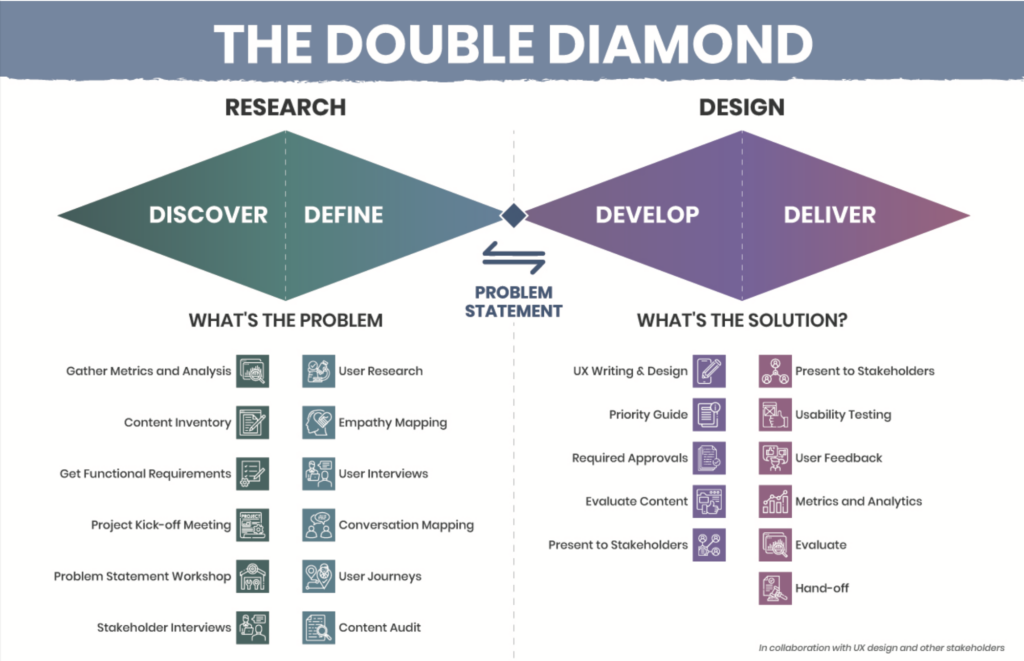
This is often the moment when practitioners start looking for better ways to advocate for the Double Diamond, not as a model to be followed, but as a way of protecting the conditions that make good decisions possible.
View the original double diamond framework
What is the Double Diamond really trying to protect?
The Double Diamond is often explained as a process, but its real value lies in what it separates. It creates a deliberate boundary between understanding the problem and deciding how to solve it. That boundary is not about slowing teams down. It is about preventing premature certainty.
In content-first terms, this separation is where meaning is negotiated before it is expressed. It is the space where teams align on what something is, who it is for, and why it matters before committing to how it will show up in language, interfaces, or systems.
When that separation is respected, teams are able to test assumptions, surface differences in interpretation, and establish shared language. When it collapses, meaning hardens too early, and content is left to clarify decisions it did not help shape.
Why does discovery so often shrink under pressure?
Discovery tends to shrink because it is frequently described as learning rather than as alignment. Learning can sound optional when teams feel confident. Alignment, especially around meaning, is harder to dismiss, but it is less often named explicitly.
In many organisations, there is an assumption that shared understanding already exists because words already exist. There are strategies, decks, value propositions, and artifacts. Yet when teams move into delivery, subtle differences in interpretation begin to surface. People are technically aligned, but semantically misaligned.
Discovery is the space where those differences can be identified early, before they turn into rework, inconsistency, or drift. When discovery is framed this way, it becomes less about generating insights and more about stabilising meaning.
How does content-first thinking change the case for discovery?
A content-first perspective makes discovery harder to treat as optional because it positions meaning as a foundational design material. Words are not simply outputs that describe decisions. They are inputs that shape them.
From this perspective, discovery is where content begins, even if nothing has been written yet. It is where teams establish the language they will use to think, decide, and design together. This includes how problems are named, how users are described, and how value is articulated.
If you are already working with a content-first framework, discovery becomes the moment where meaning is designed, not documented. This is where the Double Diamond aligns naturally with content-first design, as outlined in What Is Content-First Design?. Both insist that clarity upstream determines quality downstream.
What happens to content when discovery is compressed?
When discovery is compressed, content work tends to shift downstream. Content designers are asked to make things clearer, more usable, or more persuasive within constraints that have already been set. The work remains valuable, but its strategic influence narrows.
This is often where teams experience what looks like a content problem but is actually a meaning problem. Messaging becomes harder to stabilise. Inconsistencies multiply across channels. Teams struggle to reuse or scale content without losing coherence.
These symptoms are not caused by poor writing. They are caused by unclear or unstable meaning upstream. As explored in Media Scale Without Meaning Is Just Loud Confusion, scaling content without shared understanding amplifies noise rather than clarity.
How can UX teams advocate for discovery without sounding resistant?
Advocating for discovery does not require defending a particular model or insisting on ideal conditions. It requires changing the language used to describe the work.
Instead of focusing on research activities or phases, it helps to focus on what discovery enables at an organisational level. Discovery creates shared understanding before decisions become expensive. It reduces semantic drift as work scales. It provides a foundation that content, design, and systems can reliably build on.
When discovery is framed as content-first decision infrastructure, it becomes easier for stakeholders to see its value. It is no longer positioned as slowing delivery, but as preventing downstream confusion, inconsistency, and rework.
What does content-first discovery look like in practice?
Content-first discovery does not necessarily mean more workshops or longer research phases. In constrained environments, it often looks lighter, but more intentional.
It may involve clearer problem statements, earlier collaboration between content and product, or explicit conversations about language before solutions are finalised. The goal is not to produce more artefacts, but to ensure that meaning is stable enough to support execution.
What matters is that there is a visible moment where teams agree on what something is and what it is not, before moving into solution mode. That moment is the heart of the Double Diamond, regardless of how it is formally expressed.
Clearly defining the problem before designing solutions
Why does this matter even more as teams scale and automate?
As organisations rely more heavily on systems, templates, and AI-assisted production, the cost of unclear meaning increases. Automation does not remove ambiguity. It accelerates whatever assumptions are already in place.
In this context, discovery becomes the place where content is made safe to scale. It ensures that what is being automated or reused is grounded in shared understanding. Without that foundation, teams risk scaling confusion more efficiently.
A content-first approach to the Double Diamond helps teams treat meaning as something to be designed deliberately, not inferred later. It reinforces the idea that clarity is not a byproduct of execution, but a prerequisite for it.
Do just enough research to reduce risk
How does this reframe the role of the Double Diamond today?
When viewed through a content-first lens, the Double Diamond is not a legacy model competing with modern delivery. It is a reminder to protect the moments where meaning is shaped, especially when speed and automation make it tempting to skip them.
Advocating for the Double Diamond, then, is less about preserving a process and more about preserving intent. It is about ensuring that teams have a shared understanding of what they are building before they invest heavily in how they will build it.
For practitioners navigating these pressures, the challenge is rarely convincing people that discovery matters. It is finding language that makes its value visible in the context of scale, systems, and content.
When discovery is framed as content-first decision-making, it becomes easier to hold space for understanding, even in fast-moving environments.
View the risks of scaling decisions without shared understanding
Content-First Discovery Checklist
Use this to assess whether discovery is protecting meaning, even under delivery pressure.
Are we aligned on the problem before we discuss solutions?
Before moving into ideation or delivery, confirm that the team has a shared understanding of the problem being solved. This includes agreement on what triggered the work, what outcome success depends on, and what constraints genuinely exist versus those that have simply been inherited.
If different stakeholders describe the problem differently, discovery is not complete, even if timelines demand progress.
Do we share a clear definition of who this is for?
Discovery should surface a shared understanding of the audience, not just as a demographic or persona, but in terms of needs, motivations, and context. If content decisions vary depending on who is in the room, that is often a signal that audience meaning has not been stabilised upstream.
Clarity here reduces downstream debates about tone, priority, and scope.
Have we agreed on the language we are using to describe the work?
Content-first discovery treats language as a design material. Teams should align on the key terms, labels, and concepts they are using to talk about the problem and the solution. If important words mean different things to different people, inconsistency will surface later in interfaces, content, and systems.
This alignment does not require perfect wording, but it does require shared intent.
Are assumptions visible and named?
Discovery is the moment to surface assumptions before they harden into requirements. This includes assumptions about user behaviour, organisational priorities, technical constraints, and success metrics.
If assumptions are implicit rather than explicit, they are likely to reappear later as friction, rework, or disagreement.
Has meaning been stabilised enough to support execution?
Before moving into solution mode, ask whether the team feels confident that the problem framing, audience understanding, and intent are stable enough to build on. Stability does not mean certainty. It means there is enough shared understanding to proceed without constant reinterpretation.
If content needs to “fix” meaning later, discovery may have moved on too soon.
Can content decisions be explained without re-framing the problem each time?
A useful test for content-first discovery is whether content designers can make decisions without repeatedly revisiting the fundamental problem. If every content choice requires re-litigating intent, value, or audience, the upstream meaning may not be clear enough.
Strong discovery reduces cognitive load during delivery.
Is there a clear handoff from understanding to execution?
Even in agile or continuous delivery environments, there should be a visible shift from sense-making to solutioning. This does not have to be formal, but it should be intentional. Teams should know when they are still exploring and when they are committing.
The Double Diamond is most effective when this transition is explicit rather than assumed.
Would this meaning still hold if we scaled it?
A final content-first check is to ask whether the current understanding could be reused, automated, or scaled without distortion. If meaning only works in conversation or in a single context, it may not be ready to support systems, templates, or AI-assisted production.
Discovery that prepares meaning for scale protects future work, not just the current release.