
In large organizations, the biggest threat to customer trust isn’t bad design or weak copy. It’s inconsistent enterprise messaging — the meaning drift that happens when teams aren’t aligned on terminology or intent. When marketing says one thing, product says another, and support uses conflicting definitions, customers feel it instantly. Confusion. Doubt. Mixed signals. Every disconnected message weakens the customer journey and erodes trust, making enterprise messaging alignment not just a nice-to-have but a core business requirement in the age of AI readiness.In large organizations, the biggest threat to customer trust isn’t bad design or weak copy.
It’s inconsistent meaning.
The Content-First Framework solves this by aligning meaning before anything else. It gives enterprises the foundation to deliver consistent messaging across every team, channel, customer journey — and now, every AI system.
This guide breaks down what the framework is, why meaning alignment collapses at scale, and how enterprises can use this model to reduce friction and strengthen trust.

What Is a Content-First Framework?
A Content-First Framework is a structured system for defining, governing, and scaling meaning across an organization. It becomes the underlying architecture for every message — product flows, marketing campaigns, sales materials, support scripts, and AI-generated interactions.
The framework helps enterprises:
Align on what concepts actually mean
Most enterprise friction comes from teams using private definitions for core ideas. This framework forces agreement on terminology and mental models so every team is describing features, actions, and outcomes the same way. When meaning becomes shared, everything built on top of it becomes clear.
Create consistent, reusable content patterns
Instead of reinventing copy for every screen, email, or message, teams use proven structures for onboarding, upgrades, error states, value propositions, and AI responses. These patterns create predictable, high-quality messaging that scales.
Govern messaging across teams and channels
The framework introduces governance so language changes don’t happen at random. Teams know who approves terminology, how updates roll out, and how decisions get documented. Messaging shifts from chaos to a controlled, intentional system.
Reduce rework, confusion, and meaning drift
When teams align meaning first, rebuild their patterns, and follow governance, rework plummets. Product doesn’t need to rewrite marketing. Support isn’t left explaining unclear terms. Legal spends less time resolving contradictions. Meaning stabilizes instead of drifting.
Prepare content for AI automation and retrieval
AI can only be as accurate as the content system it draws from. This framework gives AI consistent terminology, structure, definitions, and retrieval-friendly patterns. The result: fewer hallucinations, fewer inconsistencies, and AI experiences that actually match the product.
At its core, a Content-First Framework turns content from an afterthought into infrastructure.
GOOD READ: The 5 Worst Content-First Framework Mistakes in UX and Marketing
Why Enterprises Struggle With Messaging Alignment
At scale, meaning breaks down quickly. Teams move fast, solve local problems, and invent language as they go. Over time, that creates a deep, costly misalignment.

Meaning drift
Teams describe the same feature in different ways. Customers receive inconsistent messages and lose trust.
Fragmented customer journeys
A user hears one promise in an ad, sees another in the product, and hears something else again in support. They’re left to reconcile the story themselves — and many don’t.
Conflicting definitions
Enterprises accumulate synonyms: “member” vs. “user,” “plan” vs. “tier,” “credits” vs. “points.” Internally it feels harmless; externally it creates confusion.
Skyrocketing support volume
Support becomes the translator for inconsistent messaging. When language is unclear, customers call for clarification instead of moving forward.
AI systems that amplify inconsistencies
LLMs don’t fix messaging problems; they surface them. If your repository contains mixed messages, AI will generate mixed messages.
A Content-First Framework eliminates these problems by giving the organization one shared system for meaning — finally making messaging scalable.
Good Read: Why Most Teams Think They’re Aligned and Why this Illusion is Costing ROI
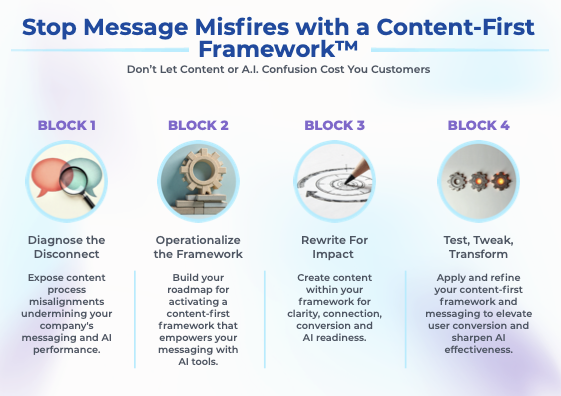
Stage 1: Diagnose Where Meaning Breaks
Before rewriting or redesigning anything, you need to understand how meaning is drifting today.
Map your message landscape
Collect and compare messaging across marketing, product, sales, support, legal, and help content. You’ll quickly spot contradictions, conflicting terminology, and patterns of drift.
Identify customer language
Analyze search queries, support tickets, research transcripts, and behavioral data. Customers often use clearer, more intuitive language than teams expect. Their vocabulary provides a reality check.
Define the critical concepts
Every enterprise relies on a handful of core ideas: value propositions, key product objects, plan structures, core actions, and expected outcomes. If these aren’t defined with precision, every downstream message becomes unstable.
Stage 2: Design the Shared Messaging System
This is where the Content-First Framework becomes the organization’s center of gravity.
Build a shared enterprise lexicon
The lexicon is the authoritative source for meaning. Each entry includes the approved term, a precise definition, its appearance in the journey, approved variants, and terms to avoid. Once teams stop inventing language, consistency accelerates.
Create systemized content patterns
Patterns turn shared meaning into reusable structures. They define the logic behind value propositions, error messages, plan comparisons, onboarding flows, and AI responses. Patterns eliminate guesswork and make messaging repeatable.
Establish governance and review
Governance keeps the system alive. It outlines how new terms are proposed, who approves definitions, how updates roll out, and how teams resolve conflicts. Without governance, even good systems collapse.
Map patterns to customer journeys
Consistency matters most in sequence. Mapping messaging across acquisition, onboarding, support, and retention ensures the story stays stable and the promise aligns with the experience.
Stage 3: Operationalize Across Teams and Tools
A framework only works when it becomes part of daily operations.
Integrate with the design system
Components should include recommended content patterns, usage notes, examples, and terminology guidance. This replaces improvisation with scalable, predictable messaging.
Equip product and UX teams
Give teams pragmatic tools: feature checklists, lexicon quick references, content pattern libraries, and clear pathways for terminology decisions. Work speeds up because teams no longer reinvent foundational messages.
Align marketing, sales, and support
External teams should use the same terminology, mental models, and structures as product. Campaigns, decks, scripts, and support macro copy all pull from the same definitions and patterns. Fragmentation disappears.
Stage 4: Measure, Optimize, and Scale
A Content-First Framework becomes more valuable as it matures.
Track quantitative impact
- Lower support volume
- Higher conversion
- Improved completion rates
- Faster time-to-market
- Less rework
- Higher NPS
- Stronger comprehension in testing
Track qualitative impact
- Fewer terminology disputes
- Stakeholders adopting shared definitions
- Customers mirroring approved language
- Research showing clearer understanding
Meaning is measurable — and when it improves, the business improves.
Why a Content-First Framework Is Now Essential for AI
AI magnifies inconsistent messaging. It mixes terminology, pulls in outdated definitions, and blends patterns from legacy content. Without governance, AI becomes a liability.
The Content-First Framework gives AI everything it needs to stay accurate and on brand:
- A governed lexicon for grounding
- Structured response patterns
- Clear definitions for retrieval
- A stable worldview to reference
- Consistent messaging across repositories
If you want reliable, enterprise-ready AI, this system must come first.
A Real Example: How One Term Changed Everything
A financial services company used “points,” “rebates,” and “rewards” interchangeably. Customers couldn’t tell whether these were the same thing or three different systems. Support spent thousands of hours explaining terminology.
After implementing a Content-First Framework:
- “Cash-back rewards” became the single approved term
- Product UI adopted it everywhere
- Marketing campaigns reflected the same language
- Support used it in macros and scripts
- AI assistants grounded every response in the same definition
Confusion vanished. Trust increased. Support volume dropped.
This is the impact of aligned meaning.
How to Start Building Your Content-First Framework
You don’t need a massive project to begin.
- Pick one high-impact journey
- Audit messaging end-to-end
- Identify the core concepts
- Create a lightweight lexicon
- Build two or three patterns
- Pilot governance with one team
- Measure before and after
- Expand intentionally
This quick-start approach proves that content isn’t decoration.
It’s infrastructure — and infrastructure scales.
Final Thought: Consistency Is a Competitive Advantage
Enterprises that align meaning at scale ship faster, communicate more clearly, and deliver more trustworthy experiences. They reduce friction, lower operational costs, and build AI systems that actually work.
The Content-First Framework is the path to get there.