Why Most Teams Work Hard on the Wrong Things
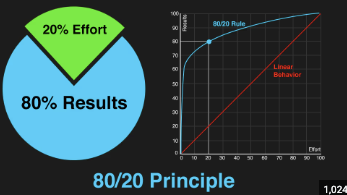
The 80/20 rule, also known as the Pareto Principle, is one of the most quoted ideas in business and one of the least applied.
You’ve heard the line:
80 percent of outcomes come from 20 percent of effort.
Most organizations nod, agree, and then proceed to spread their time, attention, and resources evenly across everything. Roadmaps get longer. Meetings multiply. Teams work harder. Results do not improve.
That disconnect is not accidental. The 80/20 rule is uncomfortable when taken seriously because it forces leaders and teams to confront a hard truth:
Most of the work we do does not matter nearly as much as we think it does.
This post explains what the 80/20 rule really means and how it applies to product, UX, marketing, and content. More importantly, it explains why ignoring it creates misalignment, rework, and meaning drift at scale.
What the 80/20 Rule Actually Means (and What It Doesn’t)
The 80/20 rule does not mean:
- Stop caring about quality
- Ignore customers outside the top segment
- Fire 80 percent of your team
- Do less work arbitrarily
What it does mean is thsmall number of decisions, inputs, and systems create a disproportionate share of outcomes.
In organizations, this shows up everywhere:
- A handful of product decisions determine long-term success
- A small set of messages shapes how the market understands the product
- A few structural choices dictate whether teams stay aligned or drift apart
The challenge is not knowing this. The challenge is acting on it consistently.
Why the 80/20 Rule Breaks Down in Organizations
Most organizations fail to apply the 80/20 rule because they confuse activity with leverage.
When teams feel pressure, they respond by:
- Adding more features
- Running more meetings
- Producing more content
- Launching more campaigns
- Piloting more tools
This feels productive, but it often dilutes focus. Instead of identifying the few decisions that matter most, organizations distribute effort across everything to avoid conflict or hard prioritization.
The result is familiar:
- Bloated roadmaps
- Conflicting messages
- UX teams fixing the same problems repeatedly
- Marketing and product telling different stories
- AI systems trained on inconsistent inputs
This is not a talent problem. It is a leverage problem.
Applying the 80/20 Rule to Product Strategy
In product organizations, the biggest mistake is treating the roadmap as the strategy.
An 80/20 product approach recognizes that:
- A small number of product bets drive most customer and business value
- Most roadmap items are incremental or defensive
- Not all decisions are equal or reversible
The 20 percent that matters in product
- Clear definition of the core problem being solved
- Explicit choices about who the product is for and who it is not for
- A small number of high-impact bets tied to measurable outcomes
- Removal of the biggest constraint slowing delivery or decision-making
What happens when this is ignored
When everything is prioritized, nothing is. Product teams end up shipping more while learning less. UX teams are pulled into execution mode. Marketing fills gaps with interpretation instead of clarity.
The roadmap grows, but understanding shrinks.
Applying the 80/20 Rule to UX and Experience Design
UX teams often feel the pain of poor 80/20 decisions without having the authority to fix them.
When UX is treated as a downstream function, teams are asked to:
- Make unclear ideas usable
- Fix confusion created by upstream ambiguity
- Polish experiences that should never have been designed in the first place
The 20 percent that matters in UX
- Involvement in problem framing, not just solution delivery
- Shared understanding of user outcomes, not just usability metrics
- Experience principles that guide decisions across teams
- Authority to challenge unclear or conflicting assumptions
What happens when this is ignored
UX becomes a cleanup crew. Designers work hard, iterate endlessly, and still feel invisible. The organization mistakes output for impact and wonders why experience quality does not improve.
Good UX cannot compensate for unclear intent.
Applying the 80/20 Rule to Marketing
Marketing often carries the burden of alignment failure.
When product meaning is unclear, marketing is asked to:
- Position unfinished ideas
- Explain inconsistent experiences
- Adapt messages repeatedly as priorities shift
The 20 percent that matters in marketing
- A small number of core messages that remain stable over time
- Clear articulation of value grounded in product reality
- Alignment on language before campaigns are launched
- Shared definitions across marketing, product, and UX
What happens when this is ignored
Marketing becomes reactive. Campaigns perform unevenly. Teams chase channels instead of fixing the message. Metrics fluctuate, but root causes remain untouched.
More content does not fix unclear meaning.
The Missing Piece: Content as Leverage, Not Decoration
Across product, UX, and marketing, the biggest missed 80/20 opportunity is content.
Most organizations treat content as:
- Copy added late
- A marketing deliverable
- A UX writing task
- Something to polish once decisions are made
A content-first approach treats content differently.
Content is where meaning is made explicit. It defines:
- What the product is
- Who it is for
- How it should be understood
- What language is canonical versus flexible
The 20 percent that matters in content
- A shared source of truth for core messages and definitions
- Early involvement in product discovery and strategy
- Clear ownership of language across teams
- Governance that prevents drift as the organization scales
When content is treated as infrastructure, not decoration, alignment improves without adding meetings.
The 80/20 Rule and AI: Why This Matters More Than Ever
AI does not create clarity. It amplifies whatever you give it.
Organizations rushing into AI often focus on:
- Tools
- Models
- Automation
- Speed
An 80/20 lens reveals a different priority.
The 20 percent that matters for AI readiness
- Clean, consistent source content
- Shared definitions and taxonomies
- Explicit decision logic
- Clear ownership of inputs
If meaning is fragmented upstream, AI will scale that fragmentation faster than any human team ever could.
AI failures are rarely technical. They are organizational.
Why Alignment Is Not a Meeting Problem
Many organizations try to solve misalignment with:
- Status meetings
- Syncs
- Steering committees
- Alignment workshops
These are symptoms, not solutions.
Alignment breaks when the high-leverage 20 percent of decisions are left implicit or unresolved. Meetings attempt to compensate for missing structure, but they cannot replace it.
When meaning is clear and owned, alignment becomes easier. When it is not, no amount of communication will save you.
What a Content-First 80/20 Strategy Looks Like
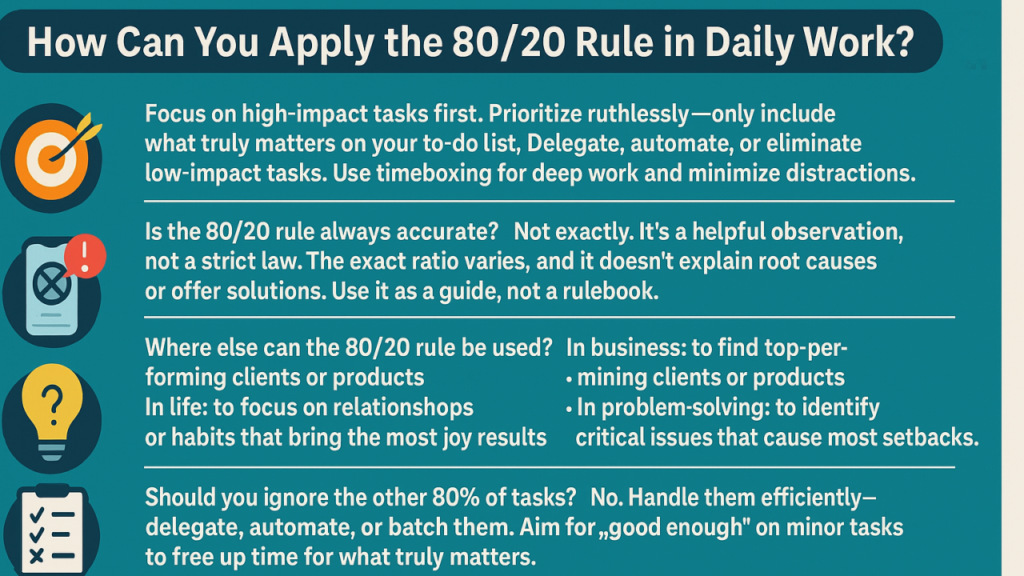
A content-first approach applies the 80/20 rule deliberately by:
- Identifying the few messages that must stay consistent
- Making meaning explicit before design and delivery
- Treating language as a shared system, not a byproduct
- Designing processes that protect clarity as teams scale
This is not about doing less work. It is about doing the right work earlier.
The Hard Truth
Most organizations do not fail because teams are lazy or unskilled. They fail because leadership attention is spread too thin across low-leverage activities.
The 80/20 rule forces a different question:
Which decisions, messages, and structures will still matter a year from now?
If you cannot answer that clearly, the organization will keep working harder without moving faster.
Clarity scales. Confusion compounds.
And content, when treated as infrastructure, is one of the highest-leverage investments an organization can make.